

Technology has changed nearly every aspect of our lives, and public safety is no exception.
One technology that has become increasingly common in communities across the country is the automated license plate reader, or ALPR. One of the largest providers of these systems is Flock Safety.
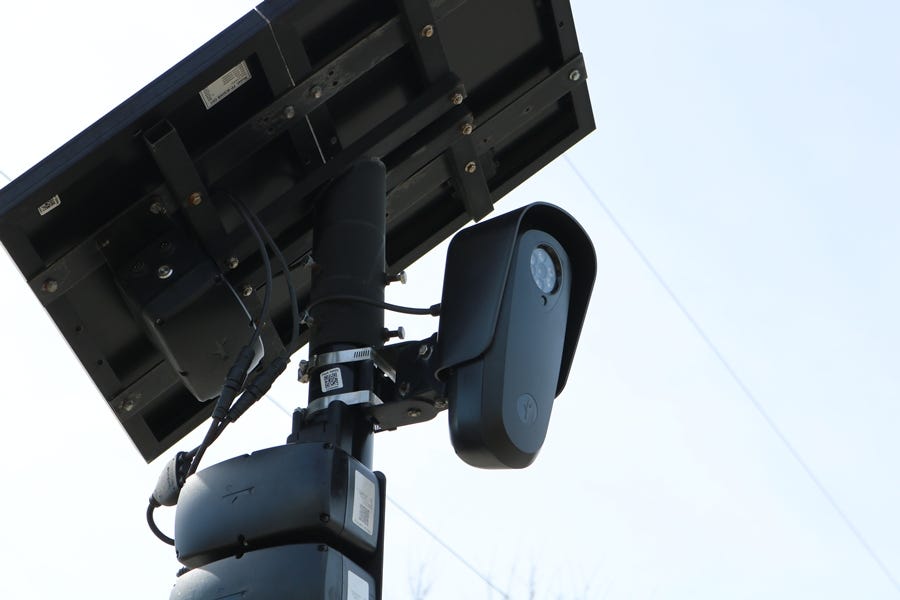
West Fargo uses Flock cameras, and like many technologies used by government, I think it is worth understanding both what they can do and the legitimate questions their use raises.
This isn’t an argument for or against Flock cameras. My goal is to provide some context for a conversation I think communities should be willing to have.
What Exactly Is a Flock Camera?
Flock cameras are automated license plate readers. As vehicles pass a camera, the system can capture information including an image of the vehicle and license plate, the plate number and state, vehicle characteristics such as color and make, and the date, time and camera location.
That information can then be searched by authorized law enforcement users. For example, a camera could identify a vehicle reported stolen or associated with an AMBER Alert and provide an alert to law enforcement.
Flock says its default retention period for license plate reader data is 30 days, after which the data is deleted. Different retention periods can apply depending upon local laws or policies.
The Public Safety Argument
The benefit of this technology is fairly easy to understand.
A police officer cannot be everywhere at once.
If officers are looking for a stolen vehicle or a vehicle connected to a crime, traditionally they might have to rely on witness descriptions, surveillance footage, traffic stops or simply an officer happening to see the vehicle.
ALPR technology gives investigators another tool. And to be clear, Flock has assisted in solving multiple crimes in West Fargo to date.
It can help identify when and where a particular vehicle entered or left an area, provide investigative leads, and alert officers when certain wanted vehicles are detected.
For a growing community with finite police resources, there is an obvious appeal to technology that can help officers work more efficiently.
There is also an important distinction between these systems and traditional traffic enforcement cameras. Flock cameras are generally intended as an investigative and public safety tool rather than something like a red-light camera automatically issuing traffic citations.
The Privacy Argument
The concerns are also easy to understand.
The overwhelming majority of vehicles passing these cameras are presumably being driven by people who are not suspected of committing a crime. Yet their vehicle information is still being captured.
One individual camera recording a license plate at a particular intersection may not seem particularly intrusive. But as networks of cameras grow, the collected information can potentially provide a much more detailed picture of where vehicles have traveled. That can understandably feel a little “Big Brother.”
Organizations such as the American Civil Liberties Union have raised concerns that large networks of automated license plate readers can effectively create databases of people’s movements, particularly when information can be searched or shared across jurisdictions.
The issue, therefore, isn’t necessarily the photograph of a license plate.
It is what happens when thousands or millions of those photographs become a searchable database.
Who Has Access?
This may be one of the most important questions for communities using the technology.
Flock says customers control their data, including who can access it and how it is shared, subject to applicable laws and contractual requirements. Data sharing has become an important part of the national discussion surrounding ALPR systems, particularly the possibility of information being accessed across jurisdictions or used for purposes the community purchasing the cameras never contemplated.
That makes West Fargo’s specific practices important to understand.
The West Fargo Police Department has disabled all sharing and the ability to share Flock data with other agencies. Access to the system also requires prior supervisor authorization.
When an officer conducts a search, the officer is required to enter both a reason for the search and a case number. Every query and action within the system is logged and tracked.
The department also conducts audits that are thoroughly reviewed to ensure the system is being used for its intended purpose. In addition, West Fargo maintains a public portal detailing usage standards and guidelines.
Those are meaningful guardrails. They limit outside access, create accountability for individual searches, and provide a record that can be audited if questions arise.
I think those details are important because the conversation shouldn’t simply be about what the technology could do. It should also be about how West Fargo is actually using it.
At the same time, good safeguards shouldn’t prevent us from continuing to ask whether our controls and transparency are sufficient as technology evolves. In fact, I would argue that is exactly what responsible oversight looks like.
Technology Isn’t Perfect
There is another practical consideration: accuracy.
Flock itself acknowledges that license plate translations can occasionally be incomplete or inaccurate and says users should verify a computer-generated plate reading before taking action based upon an alert or search.
That is an important safeguard.
Technology can provide an investigative lead. It should not necessarily be treated as proof that the person driving a particular vehicle has committed a crime.
That distinction becomes increasingly important as law enforcement agencies rely on more automated and AI-assisted technologies.
Maybe the Better Question Is About Guardrails
I don’t think the Flock camera discussion has to be reduced to two positions:
“The cameras keep us safe, so we shouldn’t question them.”
or
“The cameras collect information, so we shouldn’t use them.”
There is a lot of room between those positions.
A community can recognize that technology may help law enforcement solve crimes while also insisting upon strong protections governing how that technology is used.
In West Fargo, disabling outside data sharing, requiring a reason and case number for every search, limiting access to authorized users, logging activity and conducting audits are important safeguards.
We should understand those protections, periodically review them, and decide whether they continue to meet our community’s expectations.
A Conversation Worth Having
Technology is going to continue giving local governments capabilities that didn’t exist a generation ago, or even five years ago.
That doesn’t mean we should automatically embrace every new tool.
It also doesn’t mean we should automatically reject them.
I think our responsibility is to understand what technology does, determine whether it provides meaningful value to our community, understand the risks that come with it, and establish appropriate safeguards.
Flock cameras can be a useful law enforcement tool.
They can also create legitimate questions about privacy, data sharing and government surveillance.
Both of those things can be true at the same time.
And that is exactly why I think this is a conversation worth having.
I’ll end with a broader thought. What about security cameras at The Lights, our parks, our schools or countless private businesses? Those aren’t necessarily ALPR cameras, but some of the underlying questions are similar. Where is the data stored? Who has access? How long is it retained? What safeguards exist?
We live in a society where most of us are captured by cameras numerous times every day.
So perhaps the bigger conversation isn’t simply about Flock. It’s about privacy in an increasingly connected and monitored world, and where we as a community want to draw the lines.